thesis practise
import ArenaGrid from ’@/components/ArenaGrid.astro’; import ArenaEmbed from ’@/components/ArenaEmbed.astro’;
Forms of Resistance
Section titled “Forms of Resistance”Much of the resistive content of assemblages on Pinterest was in actionable utopias (creation, development, building, doing) and actionable dystopias (destruction, dismantling, abolition, undoing). In connecting past, present and future users were able to articulate visions of collective futures, often by making sense/nonsense (denaturalisation, catharsis, confusions, absurdism and existentialism), bringing attention to complexities of socio-economic-political climates. I interpreted content variously as counter-strategy, counter-tactics or a blurring of the two, as discussed in depth by Smolicki (2017) in the articulation of para-archival tactics. Much of this could also be interpreted as self actualisation and self-transcendence as messaging focused on the long-term capacity-building of individuals, groups and communities.
 Figure 2: mockup of a Pinterest board to discuss what may or may not be actionable, performative, or cathartic
On Are.na, content was more likely to indicate earnest exploration of a topic in depth, with less couched signals. Reference to collective responsibility was more explicit, in line with the platform’s ethos (‘About’, 2025). Fragments on Are.na were altogether more hopeful and action-focused than on Pinterest. The tone is often ‘communal, conceptual, and even vulnerable’. As reflected in the meta-analysis, this tendency can largely be attributed to the affordances of multi-modality which was explicitly valued by users. The combination of instrumental and affective fragments is more potent than on Pinterest as fragments can also be links, PDFs and embeds (for practical resources) and free-text (for affective commentary or expressing experiential knowledge). Are.na users evidenced an “embed[ded] awareness of and preparation for the future” in their curated assemblages, described by Smolicki (2017) as characteristic of para-archival practise.
Resistive Cultures
Section titled “Resistive Cultures”Tiidenberg, Hendry, and Abidin (2021) discuss the implications of multi-modality on Tumblr usage. In interviews exploring later changes to the platform, a Tumblr user shared: “I miss a space where I could explore and construct a juxtapositional, incoherent, multifaceted version of myself…a particular engaged, kind audience…a space where I contained multitudes” (Tiidenberg, Hendry, and Abidin, 2021). Are.na appears to be one such space. I found my impressions from the initial analysis echoed in the meta-analysis by users who viewed their Are.na usage as a maturation of their time on Tumblr (“post-Tumblr”, “tumblr graduation”). A sense of “digital intimacy” alongside a “pedagogy for social change” (Tiidenberg, Hendry, and Abidin, 2021, pp.135) is evident on both Tumblr and Are.na. Are.na was repeatedly deemed as ‘like pinterest but good’, or as a Pinterest/Tumblr structural/cultural mix.
As an incubator of experimental and subversive digital practise, Are.na users commonly work in public and value this open sourcing of process. This is echoed in turn by the company publishing transparent roadmaps, remaining committed to community feedback and providing open channels of discussion (‘About’, 2025). Are.na is seen by users as a new underground - a diverse, engaged community, or esoteric counter-public. Where Pinterest has been described as a ‘community of people who don’t know each other’ (Zarro, Hall and Forte, 2013), Are.na users feel closer, regarding each other as friendly strangers. Are.na constituted for them a, or the, “Good Internet”. Unlike most mnemotechnologies, it encourages the development of practises and rituals that extend beyond the platform as mnemotechniques, allowing users to ‘renegotiate’ their ‘agential dependencies’ (Smolicki, 2017). Many employ personal indexes with codes, icons and keywords imposing personal structure over the default flat ontology in practises I’d characterise as “tactical appropriation” employed “to serve a specific, individuated purpose” (Smolicki, 2017, pp. 144). Para-archival practises on Are.na are persistent, bottom-up, slow tactics that resist today’s dominant mnemotechnological silos.
(Hyper)active Exploratory Agency
Section titled “(Hyper)active Exploratory Agency”How users conceptualise their freedoms, however accurate, is of great interest here. I found that flexibility alone is a surprisingly common draw to Are.na, perhaps as ‘channels’ are so personal, reflecting a non-persistent selfhood “exposed in media, [forming] realities or identities that can be accessed, shaped, and continuously re-edited” (Smolicki, 2017, pp.63). Overwhelmingly, Are.na users extol the active agency in curation and show a strong preference for slow labour, as the literature suggested. Users explicitly express that they are anti-AI, anti-algorithm and anti-ad, or more widely that they feel in control on this platform.
The primary facilitator of more active exploration on Are.na as compared to Pinterest is its multi-directional connectivity. Threading through others’ trails of thought encourages rabbitholes of information-seeking, or “hunting for truffles in a forest”. Are.na users tend to self-identify as researchers, artists, nerds and techies with niche interests. I termed this (hyper)active exploration as a nod to neurodivergent ‘special interests’ or hyperfixations that deeply explore niche topics from diverse angles. I found largely consistent demand for “selectivity as opposed to totality” (Smolicki, 2017, pp.102), with care given to what is collected and (de-/)organised. This may ironically be enhanced by the ‘free tier’ block limit as users reflect on which resources are worth quantifiable space on servers. (Perhaps I wouldn’t feel galled by this limit if it was tangibly felt to be for local resource limits rather than an ephemeral boundary surmountable through capital, once again. I hold off on harsh judgement as the company is considering a co-operative model (‘About’, 2025)).
Reflexive Curation
Section titled “Reflexive Curation”Juxtaposing embodied, experiential knowledges with traditional sources provide reflexive space in its reconfiguration (Smolicki, 2017). Whilst some hoarding behaviour on both Pinterest and Are.na resembles “nothing more than collection” (Wolff and Mulholland, 2013, no pagination), Are.na users more often depict or explicitly strive for curation as defined prior by deliberate organisation or collection along specific themes.
The design implication of diverse practises, reflexive curation and demand for agency is to provide extensibility and not enforce one singular method of interaction. Crucially, this excludes from consideration more automated forms of curation such as those employed lately by Pinterest (Pinterest Newsroom, 2025). As discussed prior, it is in the active decisions over including, excluding, labelling and recombining fragments that their human impact is felt.
Everything Everywhere All At Once
Section titled “Everything Everywhere All At Once”Are.na is commonly described as a ‘second brain’, an extension or replacement of the first. I want to highlight the difference between these metaphors to align with Smolicki’s (2017) call for ‘synergy versus substitution’ with mnemotechnologies. Second brains are just as faulty as first brains (just differently so). Many Are.na users referred to it more as an extended memory or brain interface than party to cognition itself, which aligns with the prior discussion of externalised memory. Metaphors tended more towards brain prosthesis or tunnels between brains than to computerised intelligence.
The immediacy and transparency of the platform felt to some like ambient intelligence. There was mixed sentiment on the infinite nature of this void-like space, with some information overload and mentions of addiction or artificial highs as well as frequent praise that there was no noise to distract users from their individual goals. I believe it is mostly the ethos rather than the structure of the platform that limits feature creep and attention-grabbing behaviours. Interestingly, co-founder Damon Zucconi described the experience as ‘productive coveillance’, a not uncommon pattern of usage that nevertheless neglects the ultra-personal. Affective fragments are often intended for specific audiences and require more concern for privacy. The post-Tumblr audience values the ‘protective opacity’ of anonymity (McCracken, 2020), suggesting that surveillance metaphors are misplaced.
Porta(b)l(e) Memory
Section titled “Porta(b)l(e) Memory”This highly prevalent theme in my Are.na meta-analysis spoke directly to the infrastructure. Many users saw Are.na as a transparent portal to ‘connect us into different people’s minds’ or to their own externalised self. This title also speaks to portability. Are.na is very effective as a portal to information, due to its flat ontology and directly embedded data. For it to feel portable however it needs to be retrievable on the widest possible range of devices, in as many formats as possible and be easily ported in or out of the system at will. This requirement is where data format decisions become important and where I believe Are.na lets itself down.
The major structural limitations of Are.na are its *centralised data store and non-standard data format. I’d argue that Are.na users overestimate how reconfigurable their content is on this platform and Are.na benefits greatly from comparison to more prohibitive tools. All user data is stored centrally without options for migration (and with limited export options). The ‘Are.na commons’ is not a true digital commons as it is centrally managed and approved (Are.na Commons, 2025). Designating this space as the commons de-emphasises open channels originated by other accounts and ‘orphans’ those transferred, but does offer the benefit of disassociating from your ‘silly little ideas’. (Ironically, the author of the block I’m quoting here wished to remain anonymous.)
Whilst Are.na’s data is available via API and committed community members are extending its capacity, it would ideally be directly available in standard file formats such as markdown, HTML, JSON or XML. The fault-tolerant, resilient mnemotechnologies designed under xenofeminism and permacomputing should ‘coexist simultaneously with extant systems,” (Rettburg, 2005, pp. 2; Ingber, 2025), a priority I found lacking in both Pinterest and Are.na.
The primary limitation of Are.na is that it functions as a company first. Despite the innovative imaginings, community-centred feature development, open-sourcing of code and commitment to ethical principles, Are.na is still fundamentally business-minded, locking features behind paywalls and running as a singular closed dev team. It’s not in my interest nor skillset to conduct a full investigation of Are.na’s business practises. With wide community involvement by founders and stated plans to consider a co-operative structure in time (“About”, 2025), their commitment to their userbase is stronger than most. I consider my role here to be to explore the possibilities of tools not unlike Are.na without the constraints of capital - to remove the assumption of effective tools being measured by number of users and/or opportunities for revenue. Working from the basis of decentralised storage (in at-home, in-community or distributed servers) already goes some way to reduce costs of running central content provision.
Connectivity and Control through Solid
Section titled “Connectivity and Control through Solid”A mnemotechnique that allows reconfigurability must allow fragments to be modular, arbitrarily arrangeable and have robust fine-grained privacy so data can be (primarily) stored all in one place for an individual. Data pertaining to a collective can be stored by collectives in a model of networked stores. A network of local commons respects the situatedness of data storage in physical servers whilst prioritising accessibility and connectivity, in line with collectivist and xenofeminist desires (Cuboniks, 2019).
Whilst numerous Web 1.0 standards persist on today’s web, the Semantic Web holds weight in its focus on both human- and machine- readable data that is highly contextual, reconfigurable and structured according to self-definable schemas. In situating a solution to the task of connectivity with fine-grained privacy in the semantic web I was reminded of Berners-Lee’s Solid project (Sambra et al., 2016) and the Fediverse’s ActivityPub protocol. Momentum behind both projects seems consistent, and both retain alignment with ethical foundations. ActivityPods combines the two for decentralised communication between distributed data stores, and embedded read-write system doekieli can handle basic markdown file editing within the Solid context.
This thesis is not intended to fully articulate a fragment-based mnemotechnology using Solid, but more to call for its creation. As a ‘provotypical’ tool for thought “provoking reflection on alternate modes of personal archives and post-digital memory practices,” (Smolicki, 2017), this site is the ground from which I’m experimenting with the potential of Solid for resistive fragment assemblages, but it does not alone meet the demands of my findings.
Beyond decentralisation, the benefit of using Solid is in the hyperconnectivity it affords through semantic linking. Both the Pinterest analysis, Are.na analysis and Are.na meta-analysis highlighted the need for meaningful associations between fragments and other web content. For both Pinterest pins and Are.na blocks the connectivity and therefore usefulness was limited by a single option for source link (see Fig. 3). Are.na users valued the multi-directionality of connections between content on the platform and its graph-like traversal but made diverse use of the ‘connection’ feature. Whilst this arbitrary connection fits fleeting expression or ‘generally to-do with’ relations, many connections would’ve benefitted from structured data associated with the link. To prioritise human readability whilst making these connections useable for structured traversal, semantic statements (e.g. ‘fragment1 is-a documentType1’ or ‘fragment2 is-sequel-to fragment1’) are the preferable format. Some blocks in my Are.na analysis showed the potential of associative linking, connecting to the equivalent entries in Wikipedia, WorldCat (library search) or Google Search results.
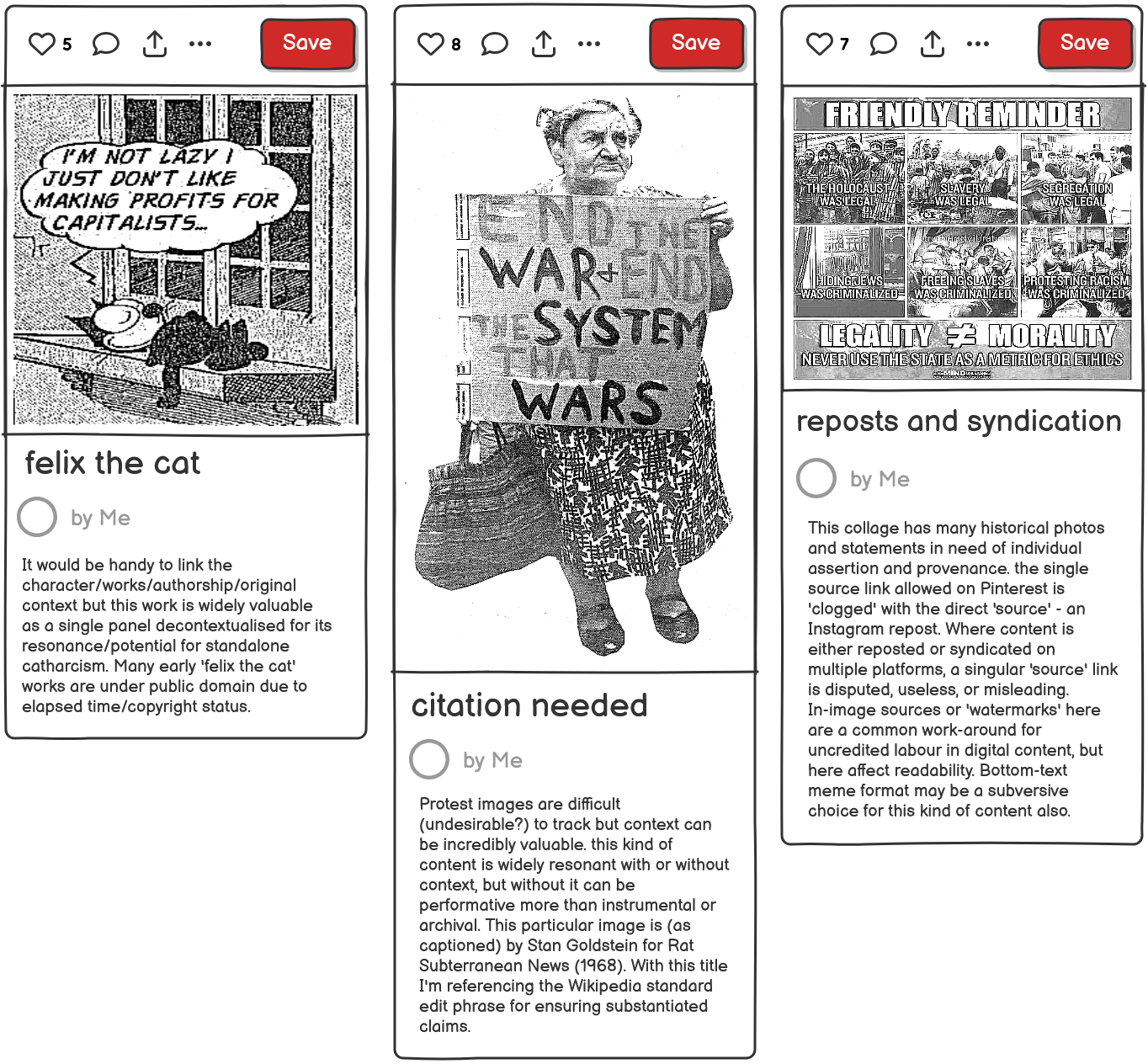 Figure 3: mockups of Pinterest pins to discuss source link semantics. Pinterest’s ‘source’ link as provenance is necessary to determine trust with historical reference such as protest images shared amongst mis/disinformation and AI-generated images. Other media such as comics and screencaps would benefit from, but do not rely on, connection to an arbitrary number of sources. Reposted or ‘syndicated’ content with a source link may be facsimile of a knowledge lineage but in practise it obscures original sources. To contrast, Tumblr’s interface separates straightforward ‘reblogs’ from those that add additional content and warrant designation in the ‘source’ link chain.
Whilst Are.na stores only a single source link as Pinterest does, its culture encourages added provenance in the text body, title, descriptions or comments, to a greater degree than Pinterest. In text blocks, users often quote or take excerpts from longer articles, which act as general inspiration on Pinterest but contain more reflexive commentary on Are.na. Many channels are designed explicitly around a titular questions, as study guides or with embedded navigational instructions. Are.na’s culture of connectivity and methods of capture encourage citational justice.
Interfacing the public, private and personal
Section titled “Interfacing the public, private and personal”For a truly pluriversal ontology, we must assume multiple views of the same data with no ‘single source of truth’. This accounts for content ‘syndicated’ on multiple platforms, for contested authorship, for untraceability of digital images and versioning. Screenshots of the same site page may be ‘collapsed’ into a singular, multiplicitous entity, an assemblage across time and space and audience.
Image recognition and machine learning methods are used variously to uncover new connections and match similar content. I’d argue a more ethical approach would be to adopt fine-grained privacy and consensual matches with omni-directional unique labelling. My findings in the demand for agency and the inherent multiplicity of digital content calls for collective assemblage that requires consent from an individual to subsume their viewpoint. This agency can be forefronted with interfaces powered by metadata properties of qualitative semantic approximation (Bergman, 2010). Insights on combining metadata comes from Web 1.0 work on forming ‘folksonomies’ from ‘personomies’ (Rettburg, 2005). CDS’ frameworks of situated knowledges support manual, self-directed translation between personal semantics and community frameworks. The crucial difference here from AI-generated categorisation is in the individual as the arbiter of ‘collapse’ or ‘equivalence’ of their terms and someone else’s. Here I’ve been using ‘alias’ and ‘peer’ properties to indicate arguably identical or notably dissimilar entities with particular nuance, akin to Wikipedia’s ‘disambiguation’. As also suggested by Ostendorff (2020) for library documents, these connections could retain the contextual meaning behind their alignment by employing semantic triples.
Fragments and their metadata can be “at the same time personal and public” (Smolicki, 2017) and so require this consensual, self-initiated association to prevent false equivalence of terms used concurrently that shouldn’t co-mingle (Dame, 2016). The co-presence of others, with control over boundaries is a common draw to Are.na, whose interface indicates the private / public / open / closed distinction prominently. As previously discussed, these boundaries allow ‘lines of flight’ to personal knowledge. Solid’s fine-grained privacy features are a strong fit for this use case. Simultaneous presence of our intra- and inter-personal notes facilitate the shift from self-actualisation to self-transcendence discussed prior. Directly overlaying comparative views or annotations could allow for situated logics of individual meaning, negotiating interpretations “either set against the hegemonic forces or compliant with them” (Smolicki, 2017). Crucially, the boundaries of included views must be self-determined and not algorithmically (read: opaquely / monetarily) influenced.
Design for Assertion (min-maxxing metadata)
Section titled “Design for Assertion (min-maxxing metadata)”This multi-root/multi-view paradigm must extend fully to metadata. Tags are seen variously as content and metadata (Berendt and Hanser, 2007; Rose, 2025; Tiidenberg, Hendry, and Abidin, 2021, pp.27), and labelling under a personal semantic framework is essential for agential curation, as shown by work on folksonomies that found individual’s tags ‘not settling on common decentralized meanings’ (Berendt and Hanser, 2007) and that people primarily tag for themselves first (Rettburg, 2005; Rose, 2025).
Basic metadata is often contestable in itself, such as the title of a place as understood by indigenous groups or international agreement. As all statements are inherently authored and need arises to refer to others without self-asserting them, both the fragment itself and its upload/modification/inclusion must retain provenance. In weighing up semantic data formats this has major impact. Either named graphs or semantic quads replace the standard semantic triple and attach context to each statement. Resistive fragment assemblages may best apply comparisons by Massari et al. (2025), as historical provenance is the most extreme or formal extrapolation of source linking.
For usability and multi-purpose usage patterns, both minimal and maximal metadata must be acceptable. In my analyses, residue of information clung to screenshots from prior collection and reposting. There are cases for this data being retained for context, provenance or knowledge lineage but also for extracting content for readability, accessibility or privacy (see Fig. 4). As contextualised and decontextualised fragments are both useful a tool’s feature set should consider both views, such as by toggling between plaintext and thick screenshots.
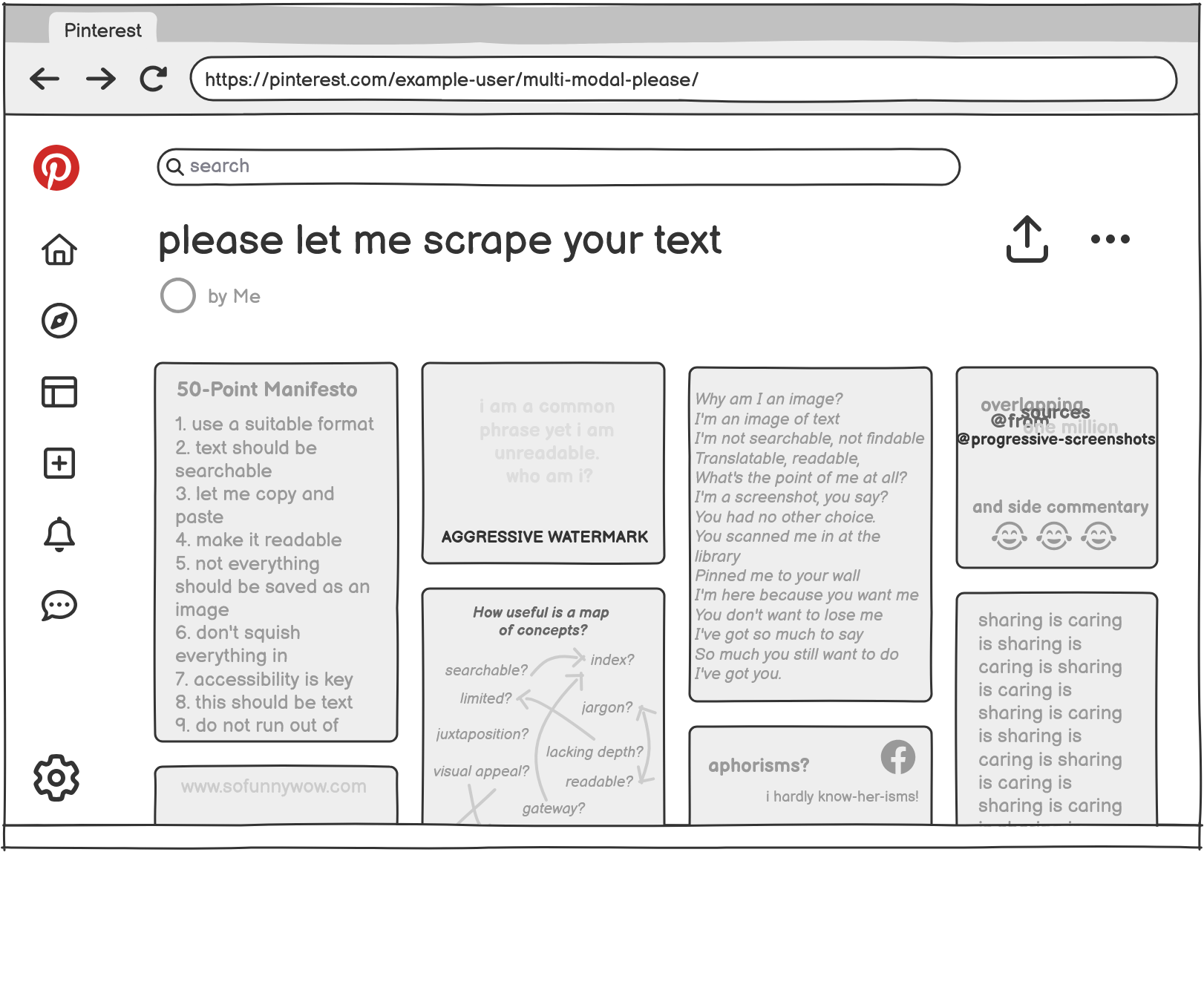 Figure 4: a mockup of a Pinterest board to discuss multi-modality, text scraping, reposting and residue