thesis context
Instrumental and affective fragments
Section titled “Instrumental and affective fragments”Critical Data Studies (CDS) allows us to conceptualise data ‘as resistance’ and ‘as latent knowledge’ (Fussell, 2022) that can be instrumentalised for socio-political change. The experiential knowledge shared online (particularly by multiply marginalised people) has such resistive potential due to its “eudaimonic (i.e., emotionally poignant, existential, or vulnerable)” quality (Moger, 2024, pp. iv). This can surface as shared joy and solidarity but also as ‘affective dissonance’ (Hemmings, 2012), where anger and grief resonates in the ‘onto-epistemological gap’ between embodied and prescripted lives (Kilic, 2024). This affect proliferated through a network directly ‘spurs action’ to bridge the gap (Hemmings, 2012). Kilic (2024), in their discussion of queer counter-archival practices in Turkey, describes how this circulation of affect allows “an everyday or individualised action [to] eventually become transformative,”. They describe the Lubunca term “gullüm alıkmak” (or making gullüm) as ‘collective act of joy or humour as resistance’ that can incite restorative change in the face of this dissonance (Kilic, 2024).
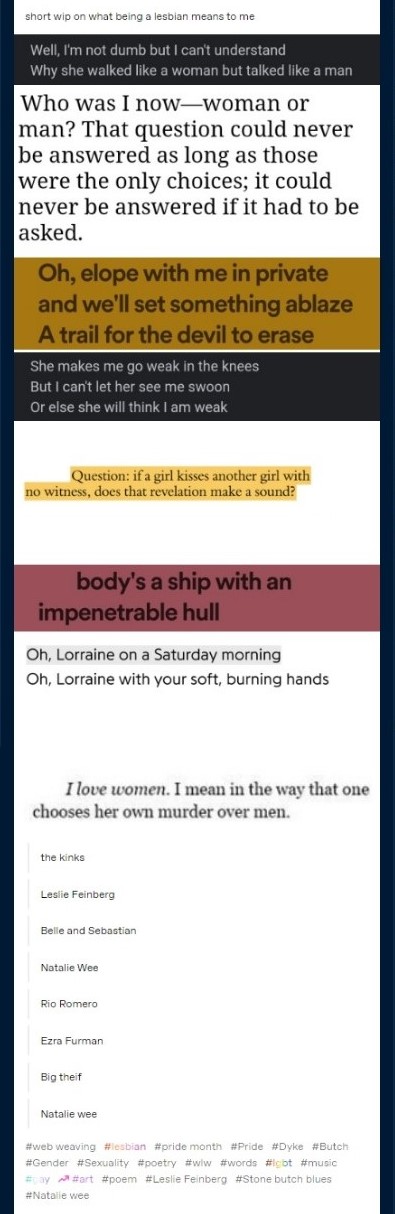
Through my own use of internet platforms I’ve engaged in information practises both as and for self-emancipation towards collective liberation. This research explores how others do the same, from social blogging platform Tumblr to ‘digital scrapbook’ Pinterest (D’Amore, 2016) and its cooler cousin Are.na. Sharing affective experiential fragments is common on both Tumblr and Are.na as they can be seen as [[Blurred Public-Private Boundaries and Ethical Practices Through a Case Study on Instagram#^452c9f|‘intimate public[s]’]] (Berlant, 2008, p. viii) of the personal on semi-public display. Users can assume a ‘common feeling’ in their ‘imagined audiences’ (Ravn, Barnwell and Neves, 2021) that allows their perspective to resonate with others of similar experience. Tumblr users assemble multi-modal fragments of both practical resources and experiential knowledge into singular affective experiences through ‘web-weaving’ (a.k.a. parallel posts or # parallels), a cross-platform practise of “transformative transtextuality” originated by Tumblr users (Rose, 2023; 2025; Moger, 2024). Both a web-weaving post (see Fig. 1), a threaded chain of ‘reblogs’ (Tiidenberg, Hendry, and Abidin, 2021) or a Tumblr blog can be considered a resistive fragment assemblage of juxtaposed elements. I’ll later discuss how Pinterest and Are.na also achieve this designation, to varying degrees.
Resistive counterpublics online
Section titled “Resistive counterpublics online”Rose (2025) describes Tumblr as a “broadly counterpublic gathering” that focuses on feminism, queer experience, NSFW topics, social justice and mental health (Tiidenberg, Henry and Abidin, 2021, pp. 9). Users describe it as “communal, consciousness-raising, therapeutic and educational” (Tiidenberg, Henry and Abidin, 2021, pp. 9). Its “persevering influence” (Rose, 2025, pp.34) on wider cultures, as the origin of shifting discourse and widely-circulated screenshots (Rose, 2025 pp.175), earns it the characterisation of “simultaneously countercultural, subcultural, and trendsetting” (Rose, 2025, pp.1).
Whilst Rose (2025) attributes desire for knowledge-building associated with fandom and “bookishness”, this culture is also driven by the structurally subversive feed-first infrastructure, allowance for anonymity and disconnection from commercial income (Rose, 2023; 2025; Tiidenberg, Hendry, and Abidin, 2021). This combination of structural potential and wider cultural influence situates the incubation of affective counter-publics online as liberatory practise. Rather than Tumblr, I’ve chosen to focus my initial enquiry on Pinterest, as it hosts similar content in its undercurrent despite being both culturally and structurally steeped in capitalist modes of production (Lui, 2015).
Pinterest is both used instrumentally and “enables the invaluable creation of information in addressing people’s affective demands,” (Lee, Ocepek and Makri, 2021). Examining Pinterest boards on counter-hegemonic topics allows us to isolate the limitations of mainstream information infrastructure and specify where multi-threaded, ‘multi-modal’ and ‘hyperconnected’ (Rose, 2025) or ‘rhizomatic’ (Tekobbe, 2013) systems would add to this combined affective and instrumental capacity.
Curating for ourselves and others
Section titled “Curating for ourselves and others”Marketed as a site for ‘inspiration’ or improving ‘life and work’ (“About,” 2013, cited in Lui, 2015, pp.129), Pinterest is a contested space of commercialisation caught in the neo-liberal trap of individualism. Its infrastructure encourages users to save with intent to purchase rather than share in a collective dream (Lui, 2015). Despite many personal boards being technically public, the mass of content affords a kind of ‘privacy in public’. Lui describes this blurring of boundaries as “the distinction between curation and collection” (ibid., pp.133), as ‘it is understood’ (ibid., pp.132), that collections are public, but I disagree; Pinterest users often don’t realise or acknowledge (Zarro, Hall and Forte, 2013; Lundgren, Curcio and Schroeder, 2021) that their pins are publicly available, using boards for “private fantasies and personal dreams” (Phillips, Miller and McQuarrie, 2014).
Collecting for ourselves and collecting for others is not always a clear intentional shift. The practise of commoning under collectivism actively dismantles this boundary, as whether the intent was first for yourself or first for the collective, both you and the collective will benefit. For metadata, research from Web 1.0 explores tagging practises as both selfish and altruistic (Hammond et al., 2005). Tumblr’s tags too are described as both personal and metacommunicative (Tiidenberg, Hendry, and Abidin, 2021). Ingber (2025) stresses the distinction between collection for yourself and for others in capturing screenshots of personal messages due to ‘privacy turbulence’, a concept elaborated by Smolicki (2017), whose “camera, always pointing outwards, covered other people” - as our intimate lives involve the intimate lives of others, our privacy is inherently contested space.
Instead of intended audience, I distinguish curation from collection by its recombinatory nature. In the juxtaposition of elements we’re offered room to reflect and rearrange (Smolicki, 2017, pp. 26, pp. 60), and so the value of an assemblage is in unique combination of fragments in differing priorities and contexts. Even in traditional curated exhibits, “the visitor is encouraged to actively […] build their own connections”, and “need not follow the same path as the curator, nor reach the same conclusion” (Wolff and Mulholland, 2013). To learn from what you’re consuming, there must be deliberate “interpretation and organisation” of information (Wolff and Mulholland, 2013). Nomadic data discourse in CDS describes how the recombination of data fragments has unlimited potential for qualitative transformation, unlike statist treatments of quantitative data. Here, fragments can ‘enter into new combinations without arbitrary limit or so-called “natural” or “hierarchical” uses and meanings’ (Nail, 2017: 32-33, cited in Fussell, 2022).
Intersubjectivity
Section titled “Intersubjectivity”As individuals, our situated singular perspective is the interface to the collective. The point at which our own frameworks diverge from another’s can then be of “powerful personal significance.” (Smolicki, 2017, pp.146). Smolicki (2017) describes personal, intentional, curational practises as ‘para-archival’ in that they “foreground the accounts of the everyday that are formed singularly and silently from within”, parallel rather than counter-to hegemonic strategy (Smolicki, 2017, pp.137). I attend to para-archival as para-tactics: an extension beyond the dichotomy of strategy vs tactics where “resistance seem[s] to emerge slowly, stubbornly, and persistently, over longer periods of time” (Smolicki, 2017, pp. 117, 145).
A singular subjectivity is in many cultures the determinant of a ‘self’, but I prefer to define it as a “multidimensional construct containing both one’s intra- and interpersonal beings” (Maurer et al., 2023). Both “personal and collective experience are intertwined” (Rose, 2025, pp. 36; Tiidenberg, Hendry, and Abidin, 2021) on Tumblr, and Pinterest boards are formed on personal semantics that are influenced by but distinct from other users (Tekobbe, 2013). As affective technologies can “combat alienation from oneself and others.” (Moger, 2024), such platforms preclude an interdependent selfhood inherently connected to context and to other people (Smolicki, 2017, pp. 219). In combining fragments for both “practical and conceptual needs” and the “transpersonal welfare of the collective” (Lee, Ocepek and Makri, 2021), networked assemblage constitutes resistance to individualism and universalism.
In combining individuals into wholes, the current era of innovation period largely focuses on the aggregate, increasingly in the form of large language models (LLMs). I’d argue that the only ethical form of “linguistically generated intersubjectivity” (Habermas, cited by Rettburg, 2005), combines individuals through active consent, direct participation and minimal remediation, in order to represent “alternative, non-centric conceptual zones, fluid individual practices and imaginations” without subsuming these peripheries into a new centre (Fussell, 2022, pp.15; Smolicki, 2017, pp. 47). This would constitute Smolicki’s ‘responsible construction of subjecthood’ (2017, pp. 74), through ‘folding’ or ‘internalizing’ of outside forces (Deleuze, 1991).
External mnemonic traces, particularly by marginalised people, can construct counter-publics as resistive communities form through trans-individuation (or, shared meanings) (Smolicki, 2017, pp.54). Both Moger (2024) and Smolicki (2017) discuss external archives in terms of self-transcendence, at the (later added) peak of Maslow’s hierarchy of needs. Whilst Maslow’s concepts are useful in categorising practical and relational needs, representing individualised needs in a hierarchical relationship with the collective is an inherently Eurocentric paradigm, misrepresenting the worldview of the Blackfoot nation that inspired it (Kapisi, Choate and Lindstrom, 2022).
I’ll instead frame general purpose assemblages (of inherent non-linearity) as meeting each need in parallel. Para-archival practise conducted in networked space acknowledges ‘the heterogeneity and plurality of micro-perspectives” (Smolicki, 2017, pp.137), in appeal to pluriversality through “subjectivity shared with others” (Rettburg, 2005). In my own experience I relate this concept to holotropism: articulated by Mirra (2023) as a combination of monotropic theory and deep ecology through the lived experience of specifically autistic ‘coherence’, ‘wholeness’ and ‘effortless integration’ with all interconnected things (Mirra, 2023; (Chattopadhyay, 2024).
Decentralisation and Data Ownership as Resistance
Section titled “Decentralisation and Data Ownership as Resistance”If material mnemonic traces can constitute the self (Smolicki, 2017, pp. 219), ownership and privacy of this self is important. Through the forced technological progressivism of Web 2.0, individual archival practises have been transformed, ‘contaminated and instrumentalized by economic, commercial, and political agendas (Smolicki, 2017, pp. 111) in an era of widespread platformisation under capitalist realism (Fisher, 2009). These ‘easily monitorable mnemotechnological enclosures’ (Smolicki, 2017, pp. 62) are able to dominate attention, meaning-making and privacy as they “make people adapt, somewhat passively, to their internal rules” (Smolicki, 2017, pp. 56-57).
The primary structural features of a more equitable internet are decentralisation and data ownership. We can strengthen networked technologies of the self (Rose, 2023; 2025) through the ‘ideological infrastructure’ (Cuboniks, 2019) of data sovereignty, or, the rights of users to their own externalisations. If we choose to engage with mnemotechniques as “intentional practices of externalizing memory and knowledge” (Smolicki, 2017, emphasis added) we can regain or retain agency within cultures of automated data capture. Smolicki (2017) describes this as a shift from passive to active forms of remembering, or from ‘capturing’ to ‘recording’. Citing Steigler’s ‘originary prostheticity’ (1998, p.153), Smolicki also claims that external memory cues or mnemonic traces are ‘inseparable’ from internal structures (Smolicki, 2017, pp.53-54), justifying the use of mnemotechnologies that better enable mnemotechnical practise. If we reject the notion of the ‘natural’ as the sacred (Cuboniks, 2019), there is no consistently meaningful boundary between body and tool. As a disabled and neurodivergent scholar in particular, I demand higher standards of autonomy over data mind-bodies.
Another motivating goal that is “both utopian and practical” is that of permacomputing - to maintain robust, future-proof technological systems with reduced environmental impact. Decentralised systems for data storage and backup are more robust against technical faults (Hafner and Lyon, 1998, p.27), natural or political crises (Abbate, 2000) and isolated impacts on a singular company’s servers. Even in accessing Are.na during research I was afforded an ironically fortuitous example of single-point failure when a Cloudflare fault took out Are.na along with much larger sites (McMahon, 2025).
Data ownership is a more widely contested issue, with companies claiming rights over data for which they’re ineligible, in order to profit from its exploitation (Versaci, 2018). Critical Data Studies emphasises the reduction of harm to marginalised groups in use of their data, calling for more control over when we are required or coerced into giving certain data and more robust consent mechanisms. Self-storage (or at least a diverse range of storage providers) for personal data with fine-grained access control (Sambra et al., 2016), as well as compliance from end applications, is necessary to prevent unwanted harvesting or leakage of personal information. More assurance of privacy and the scope of audience for individual fragments can enable the prior discussed intimate counter-publics, incubating resistance and wider systemic change.