Pinterest analysis details
Methods
Section titled “Methods”Due to the vast sampling population and topics I knew I wanted to discuss I focused on boards featuring: a) future-building and inspiration b) actionable and non-actionable tasks c) mixed content types and multi-modal objects d) connectivity, provenance and further resources
I ended up with 32 boards that would be suitable for analysis, 7 of which fit maximal criteria for selection.
- collected all Pins and metadata from these boards
- conducted informal thematic analysis
- a mixture of inductive and deductive coding
- descriptive, then interpretative coding
- selection of the most interesting/relevant/valuable codes and the best examples of each
- characterisation of some through wireframe sketch
I selected the more valuable emergent themes to discuss and combined these with insights from literature to form the below characterisations. I’ll go on to apply them to selected Are.na channels to see where the different infrastructure and community ethos corresponds to a comparison, contradiction or extension to each themes below.
Themes
Section titled “Themes”| description | details | |
|---|---|---|
| hyperconnected | instructional diagrammatic Pin linked to relevant resource, reasonably sourced historical claims, quotes directly linked to source | |
| Tumblr thread of gold | Tumblr screenshot linked back to the post, which itself links resources | |
| wrong format | image-first platform infrastructure hampering the usefulness of the item with irrelevant or secondary data as image or metadata. only here out of convenience of keeping everything together. book list as video and album as photo | 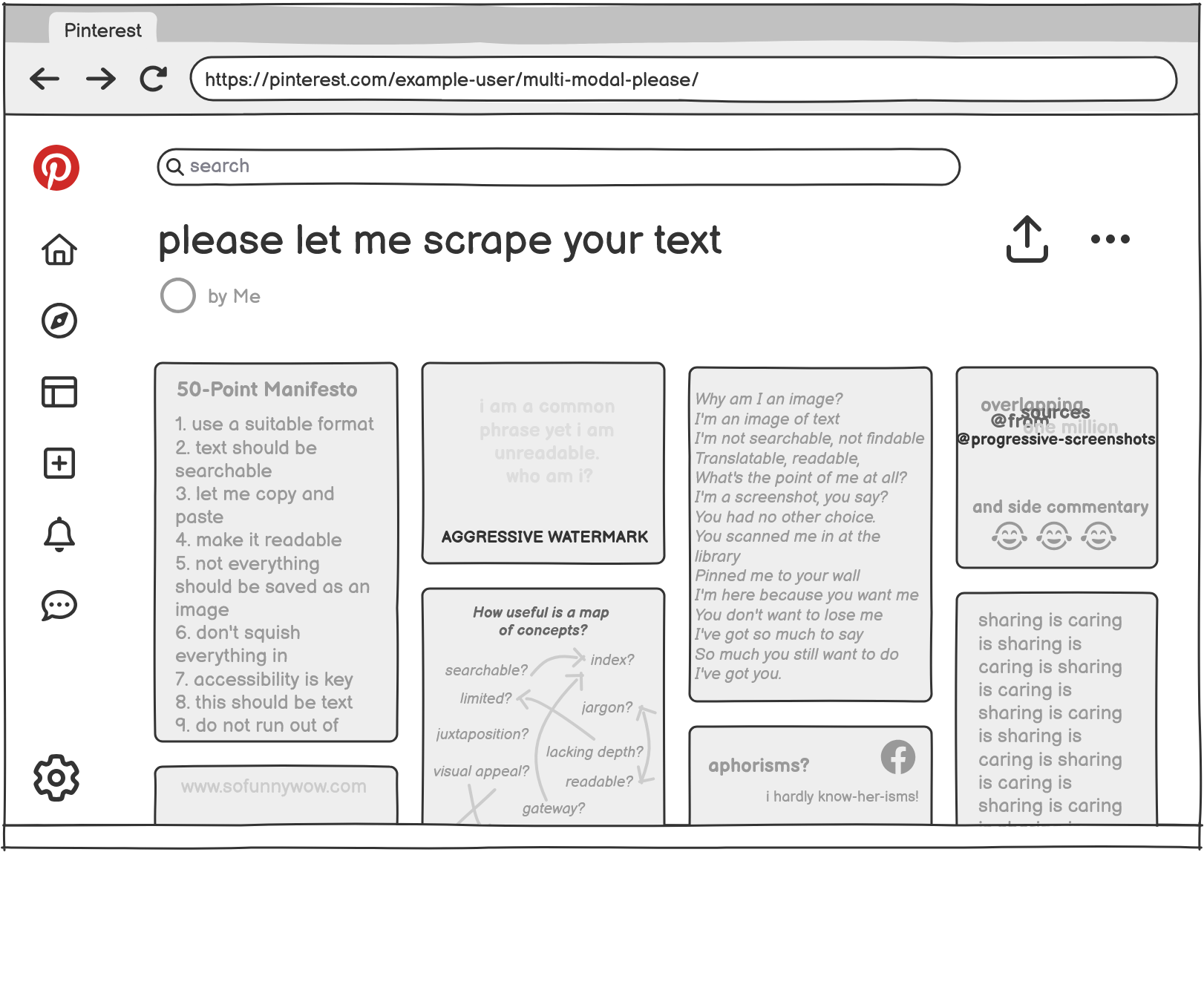 |
| citation needed | unlinked historical claims, protest signs without context, unlinked quotes | 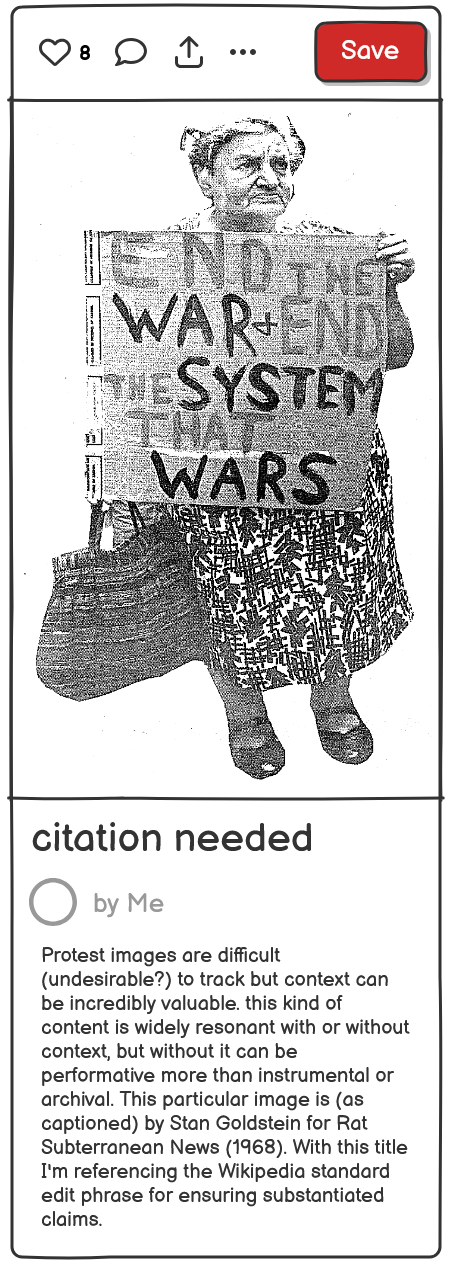 |
| source link semantics | for screencaps, comic panels, posters, general media sources - context would be nice but isn’t necessarily instrumental. broken links. art is inconsistently linked to artist, sales platform or resources. ‘source’ link as a singular option doesn’t allow semantically useful connections or pluriversal knowledge lineage | 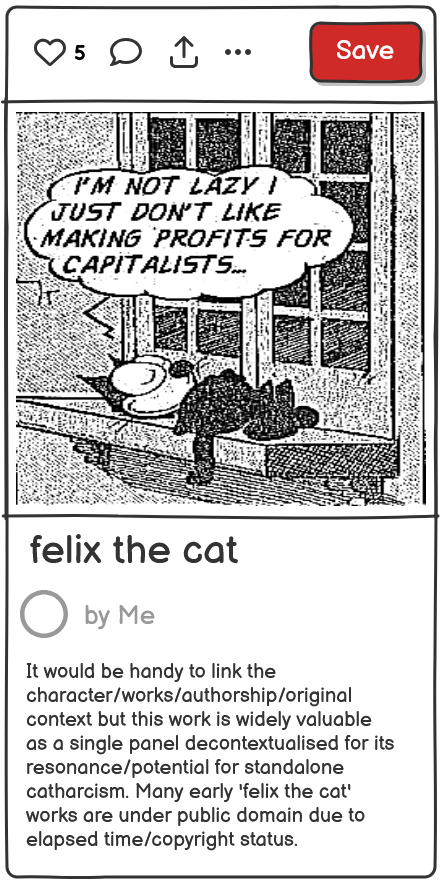 |
| reposts and syndication | source linked to another instance of the same content, shows need for content to live in multiple platforms but clogs up the only ‘source’ link avaliable and acts more as a bridge between social media audiences than between related content | 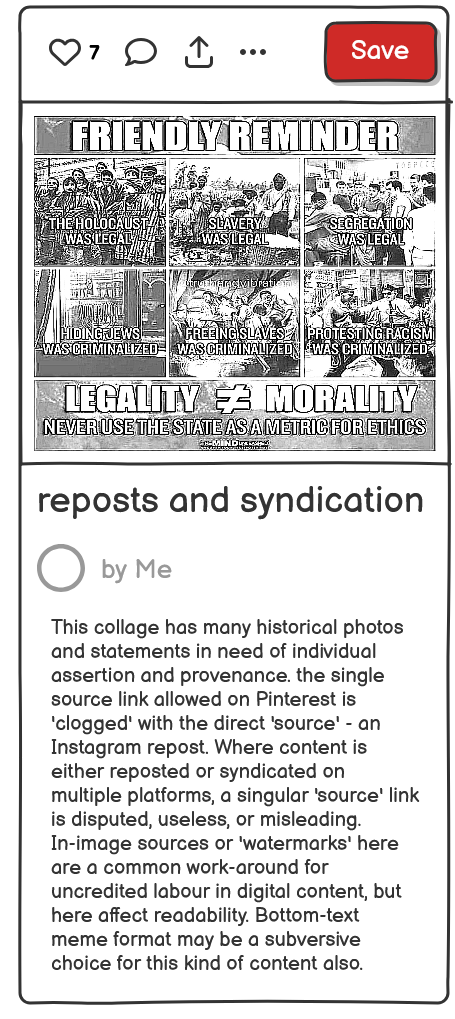 |
| image as data, image as gateway | image/link combo as a rich data object eg book covers and reading lists (data both in image and link). image as a façade, containing source links as text, or otherwise circumventing the image-first infrastructure, linking to a like-minded community | |
| image assemblage | traditional collages, extensive meme edits or use of the newer ‘collages’ feature. frequently providing difficulties for users wanting to source individual elements. see ‘imagesnippets’? multiply-overwritten memes requiring something less like traditional sourcing and something more like asserting the chain of authorship of elements, knowledge lineage. extensive meme edits akin to collage often hold in-group references requiring extensive sourcing in other contexts, but are often unsourced | |
| memes as formatting | use of very open meme format for extensive text resource or assertion, format as inessential general context. Image assemblage and remix is a wide topic of investigation just outside of the current scope, but I will highlight the prevalence on Pinterest in particular of a particular class of meme formats. The examples here both use a format for arbitrary blocks of text, where the text is the main content but the surrounding scene and/or character acts as a tonal indicator akin to facial expressions alongside spoken word. Each format under this class adds a slight nuance to the assertion or instruction made in the text. This is of particular interest as it is predictable and lightweight form easily expressed in text decoration akin to italics, whilst retaining both human and machine readability. | 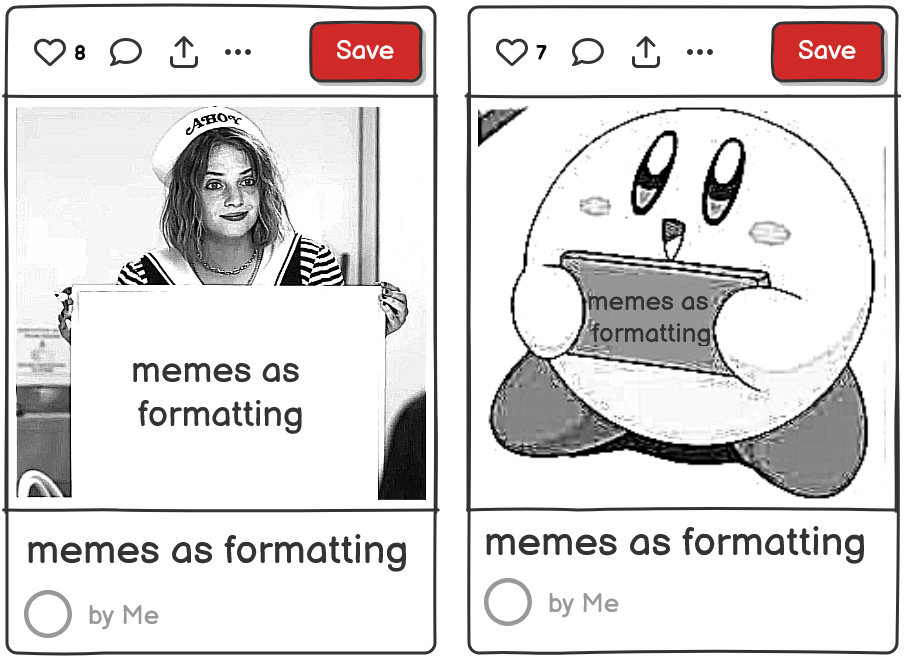 |
| ‘vagueposting’ revolution | ironic, threat softened, using screencaps/comics/fiction/humour to relate/retain denial/ambiguity of intent, signal directly and indirectly to multiple audiences at once | 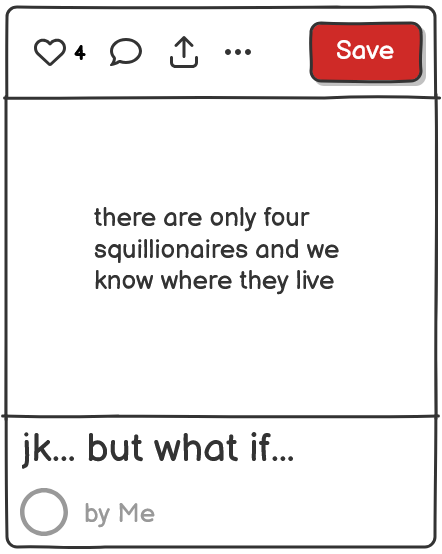 |
| actionable utopias | creation, development, building, doing | |
| actionable dystopias | destruction, dismantling, abolition, undoing | |
| self-actualisation and self-transcendence | long-term capacity-building of individuals, groups and communities | |
| making sense/making unsense | denaturalisation, carthartic, complexities and confusions, absurdism and existentialism | |
| connecting past, present and future | directly compared utopia/dystopia, or: what we have now, what we shouldn’t have now, what we shouldn’t have later, what we could have later | |
| pinning likely doesn’t signal intent | specific incendiary acts called for but likely not enacted, as in (Dolphin, Char, and Rogers, 2024) (just pinning is different from engaging with content to make change) | |
| screenshot provenance | screenshotting can be from necessity, as the most feasible/comprehensive method of capture, even if it loses some info - some dialogues and continued threads link directly back, others are missing valuable data, others contain provenance in the image text. Twitter screenshots in particular (as the second most common source I found, after Tumblr) have gained more nuanced questions of reliability through the influence of Musk | 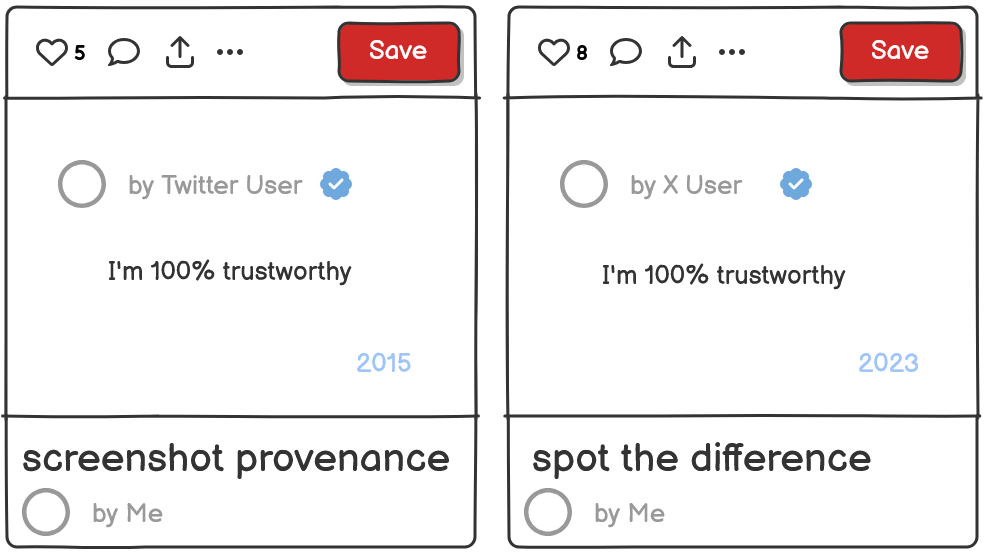 |
| collection, not curation | mass data loosely tied, unlikely reflection of elements and placement has taken place, possibly hoarding, performative aestheticisms, etc | |
| strategies or tactics? | evidence of counter-strategy, counter-tactics, or a blurring of the two, as in (Smolicki, 2017) |
Some Discussion
Section titled “Some Discussion”hyperconnected para-archives
Section titled “hyperconnected para-archives”Pinterest held more evidence of hyperconnected knowledge than I expected. I found instructional diagrams linked to relevant resources, historical claims and quotes connected to primary sources or secondary resources linked through Tumblr threads of gold. In descriptions, titles, watermarks and comments there were creative acts of resisting the site’s capital-oriented architecture through additional provenance, directly actionable pins and gateways to alternative communities. This appropriation of tools can be considered para-tactical assemblage of para-archives.
image-first infrastructure
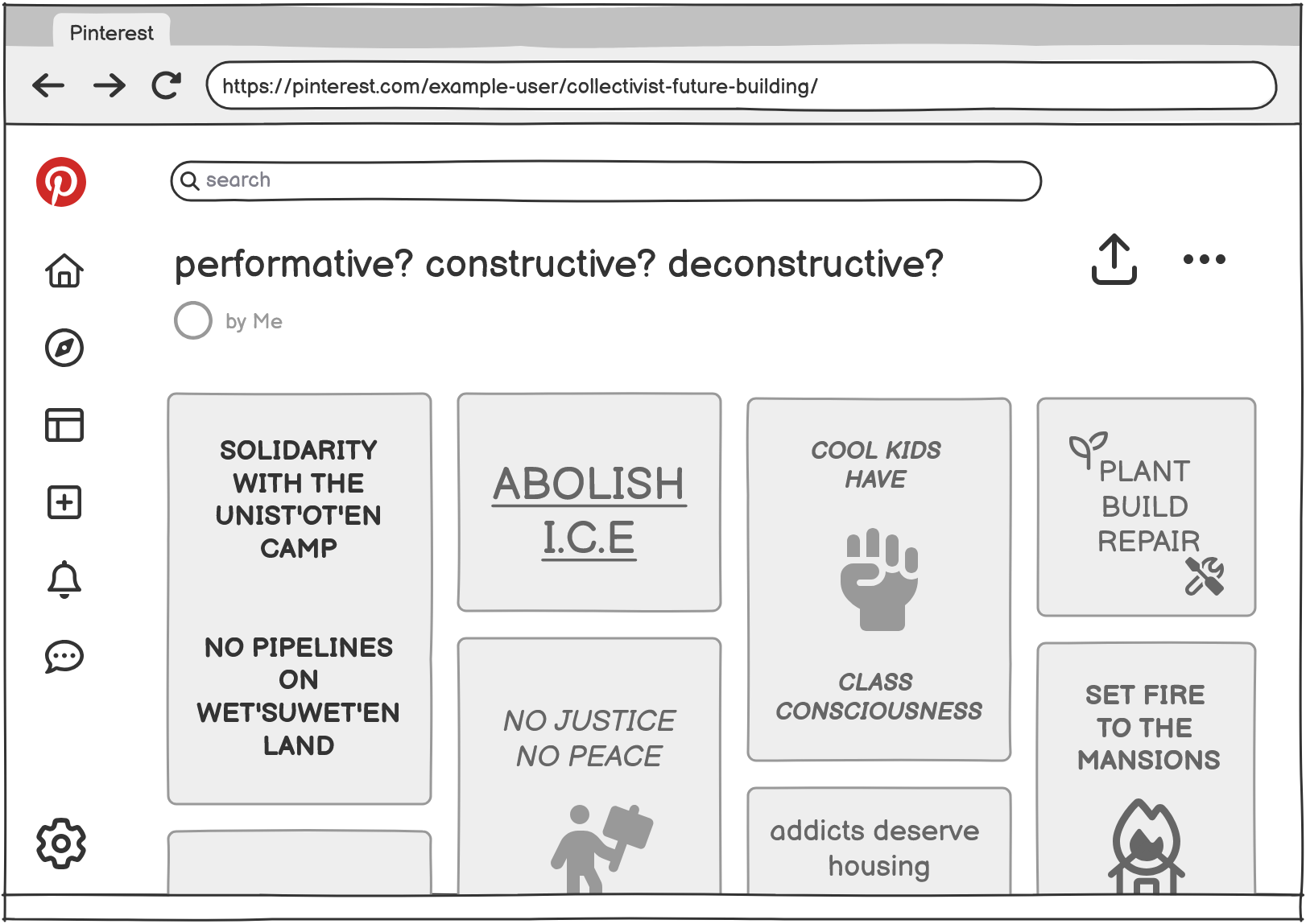
Section titled “image-first infrastructure”A particularly interesting circumvention of the image-first infrastructure was the use of image as data in the form of visual book lists, book covers and spines. Research is ongoing within library sciences to connect metadata with images of shelves (Zhou et al., 2022) which could be extended over these networks to associate predictable image forms. Many pins contained fragments of text within them, raising the question of what counts as an atomic fragment. I found a strong presence of decorated text-blocks and slogans from which the primary content is easily ‘scraped’, but the formatting might provide important context. Screenshots particularly often hold metadata and provenance. Elsewhere I discuss the value of viewing these fragments both contextualised and decontextualised.
Additionally, many pins I’d describe as concept-mapping or otherwise diagrammatic. These textual forms would be more suited to alt-text or annotation than text-scraping as the visual elements hold more crucial information. Often these pins could make better use of hypertext in encoding semantic information visually in live code rather than as image, but this would necessitate manual translation of decades of digital image to reinterpret and replace commonly saved diagrams.
vagueposting revolution
Section titled “vagueposting revolution”A notable class of pins used irony, humour, vague language or appeal to in-group language to discuss incendiary political acts. Softened threats and speaking through others (screencap captions, gifs) dissociated posters from the acts described. Whilst catharcism like this is common and pinning doesn’t necessarily entail engaging with the content to make change (Dolphin, Char, and Rogers, 2024), this ambiguity enables a resistive counter-public that retains denial of intent or purpose. Signalling directly and indirectly to multiple audiences at once allows resistive unity without the specifics that individualise and identify authors - another benefit of decontextualisation.
Some Meta
Section titled “Some Meta”Consent
Section titled “Consent”- thoughts on need for consent for public data analysis here ->
- I contacted each user for explicit consent to analyse this data in anonymous form, through Pinterest’s messaging system, but didn’t receive any responses. I chose to include my analysis without any reference to the specific boards I analysed.
Minor notes
Section titled “Minor notes”- I did not rigidly structure my analysis nor combine it with quantitative frequency analysis as I was interested more in relative frequencies to my expectations and in interpreting the juxtaposition of particular ‘pins’.
- The initial/additional codes I didn’t select can be read here ->
- Details of procedure can be read here ->.
- Tags aren’t included as they are not user generated, but created by user behaviour in the machine learning interests taxonomy and so are directed at business interest rather than the intentions and desires of the users.
- In general observation, titles and descriptions are almost always redundant to alt text, errors/placeholders, not immediately relevant to the content or not adding much context (additional minor commentary)